The Picts

 They may be the most interesting people you’ve never heard about. In the original outline for Draegnstoen, they were not a part of the story, but as the book developed, I knew they could not be left out. The sequel to Draegnstoen, Highland King, is truly a story of the Picts.

They were probably the first inhabitants of Scotland, arriving sometime during the Iron Age. Though theories abound, we have no idea where they came from. Their language is like no other, almost completely unrelated to any other Indo-European languages. We only have just over 100 words of their tongue, mostly proper names and place names like Aberdeen, and Lhanbryde.

The Romans called them “Picti”, meaning “painted”, in reference to the tattoos that covered their bodies. This unknown northern people, now extinct, were the reason Rome could not conquer all of Britain. Rome attacked their lands in northern Britain, time and time again, killing thousands of the Picts, but they would not submit. Finally, yielding to the tenacity of the Picts, the Romans, in 122 AD. began to build Hadrian’s Wall, east to west across northern Britain. It fortified their northern boundary. An empire that was always expanding stopped here and could not advance. The wall was a monument to Roman failure, one that has stood for almost 2000 years. Rome also built Antonine’s wall, further north, but could never hold it. The Picts would not accept that further incursion into their territory.

But who were the Picts? Like the Scots that followed them, some sources suggest they had a matrilinear succession to their kingship, a complicated path to the throne that passed from uncle to nephew and actually encouraged the regicide it was designed to prevent. Theirs was a bloody line of succession.

They did not use the name “Picts”. They may have called themselves “Cruithni”, and much of their early history is lost in myth. It is popularly believed that there were seven ancient Pictish kingdoms that gradually consolidated. The Pictish Chronicle is an early document that attempts to document their history and their kings, but it is confusing and often contradictory. They left us many curious engraved stones scattered about the land, some marked with Christian symbols, earlier ones marked with serpents and fantastical creatures. The picture of the stone circle at the top of this page is another of the monuments they left us.
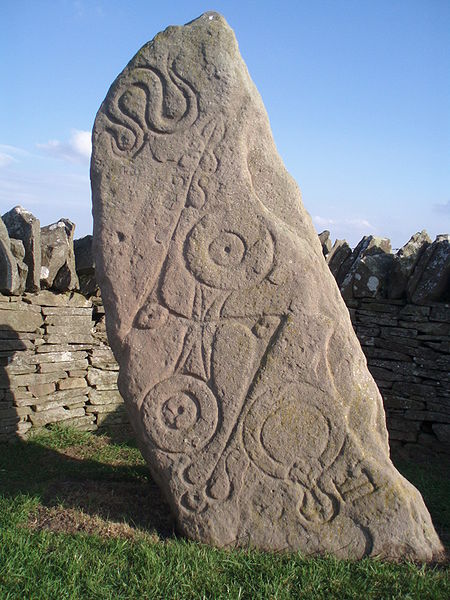
The Picts went into battle naked, their bodies painted blue with woad. Remember “Braveheart” and the Scotsmen with blue paint on their faces? This tradition was handed down from their Pictish ancestors, even then extinct for almost 400 years.

We know that as of about 800 AD they were still a distinct people, although at that point on the brink of being assimilated by the Scots. Kenneth McAlpin (d. 858 AD) was titled “King of the Scots and the Picts” and some theories suggest that his mother’s family was Pictish nobility.  

As I have researched Pictish history, I realized how little of their story has been told and how little is truly known, often filled with qualifiers like “theory”, “suggest”, and “perhaps.” There are too many pieces missing to “know” all we may want to learn about this people.
Theirs is a tale rich in legend, and the magic of the fog shrouded mountains, the rainy, wet highlands and cold Scottish lochs. It was an ancient kingdom torn asunder, north to south, attacked by an invading people from the west. They were a people with the boldness to claim their divine right of kingship even from the Book of Genesis in the Old Testament.

Who were the Picts? The history books say little. Listen to your imagination. It will tell you the rest of the story.

Posted in Uncategorized | 2 Comments

The Song that is Your Story

A number of years ago I was at a concert. About halfway through, the stage went dark. A few minutes later, a spotlight came up, illuminating Paul McCartney. He was sitting on a stool, holding an acoustic guitar. I took a breath and waited. The familiar short guitar introduction wafted through the air and then I was watching and listening to the composer, the singer and lyricist sing “Yesterday.” Amazing. No string accompaniment, just a poet and his guitar.

Some years later I sat in another concert. The stage had gone dark again, and this time a blue spot came up, showing Billy Joel at his piano. And then he sang “And so it Goes.” Again, no other instruments, just the man and his piano.

They both sang songs about the joy and pain of love. They were familiar songs and familiar emotions. The poetry was so powerful that it almost stood on its own, needing only the barest musical support.

Last concert example. A few years ago, my wife and I went to go see Fleetwood Mac. It was a summer night and we sat outside on the grass. The music started and they played all the great old songs. At a certain point in the concert another song began, their newest hit; Say You Will. It was fantastic to hear it in concert. This afternoon I was listening to my IPod and that song began again. Away from the concert arena it was a different experience.
It’s a catchy song, but the lyrics are not profound. Listen carefully on the IPod. Maybe at a concert the song just sort of overwhelms you, but with those ear buds in, you really hear what the song is about. There’s an acoustic guitar playing, and not one electric guitar, but two, perhaps even a third, playing a different part. After the beginning, Stevie Nicks voice comes in again, doubled. The bass and the drums are there of course, but listen, there’s the organ – Sheyl Crow.  (By the way, she’s also doing background vocals on this song). There are other singers in the background too, and it all comes together in that lush soaring trademark sound.

That’s the way most songs are, not just the lyrics, but all the pieces working together to take you away for 3:30, maybe a bit longer. The words and sound give you an experience that keeps you going back for more.

Your story is like a song. Oh, you can just tell a story, but it’s the texture, the extra layers that make it rich and full. An intriguing subplot, symbolism, the right metaphor, an original idea, great characters. Now its not just a story, but something people can relate to in many ways, each one unique.
Unlike a song, you don’t have just three and a half minutes. You get a few hours with the reader; you get thousands of words to weave your magic. But the expectation is much higher, your responsibility is greater. You’re not layering sounds, but words.

Your imagination and emotions are transposed into black marks on a white page. Light takes those images into the brain of your reader. If you’ve done it right, the reader has caught your vision, laughing where you did; the lump you had in your throat when you wrote a passage becomes a tear in the eye of the reader.  The satisfaction you had upon finishing your story brings a smile to the face of your reader when they reach the end with you. Consciously, you take that journey in writing the story, but everyone who reads what you have written takes you again on that odyssey with them. If you have sung your song well, your words, in some small way, will always stay in the heart of your reader. To write; it’s an amazing thing, a magical experience.

So; sing your song.
Tell your story.
Weave magic.

Posted in Uncategorized | 1 Comment

Untying the Knot

Your main character has just triumphed, or perhaps, if you are writing a tragedy, the heartwrenching climax of the story has occured. Regardless, that moment your protagonist has been moving toward since page one has just happened. You have skillfully navigated your reader through all of the adventures of the story, developing character, imparting your message, delivering excitement, drama, or perhaps even inspiration. Now what? The lovers have reconnected, the battle has been won, the bad guy has been vanquished. You can’t just stop writing. Well, maybe if you do it just right you can, but often far better to have a short but gentle finish, an afterglow to the climax. You are ready to write the Denouement.

The what? No, its not pronounced Dee-noo’-mint. It’s Dei-nu-mah’ (with a hard “a”), or perhaps if you wish, Dei-nu-mahn’ (with a barely heard “n”). Now you won’t be embarrassed the first time you say it outloud in the company of writers. You’re welcome.

But what is it? French for “Untying the knot”, it is the end of your story, that short little piece that comes after the climax. It wraps up loose ends. In case the outcome was unclear by the end of the climax, it reassures us that we got what we came for. If the climax is the adrenaline rush of your story, the denouement is the smile at the end. Its the goodnight kiss; or as only Spielberg could pull off, it’s Indiana Jones riding into the sunset.

You may have figured out how to write your story all the way through the climax, but the denouement seems more intuitive. You may not know what it is going to be until you get there. I had a good idea of how to end Draegnstoen, but that last, satisfying paragraph didn’t manifest itself until the very end. And then the idea just happened, a small, almost insignificant thing intended to provoke the barest hint of a sad smile. Does it work? Well, we shall see.
But if everything else in your story works and then at the end, you “untie that knot” with just the right subtle flourish, you have won over the reader.

Posted in Uncategorized | 1 Comment

When does it become real for you?

This post is a question for writers. There is an interesting part of writing a novel that I have long been curious about. I hope some will respond.

You have an idea for a story. Maybe you’ve outlined the story, written a pitch, done some character sketches. Perhaps you’ve worked out some scenes in your head. Maybe for you, a movie plays in your head of the completed chapter and then you can write it down. That’s how it works for me. But at the beginning, it’s an idea, a story known by only you.

Even when the first words go down on the page it still seems ephemeral, more smoke and shadow than substance. Even a couple of chapters into it there’s not much to grab onto; its still like trying to take hold of a cloud. And then, somewhere along the way, it becomes a thing of tangible substance. The fog melts away and there is somehow a foundation where there once was none. There is form and shape. If you look away for a moment and then glance back, it’s still there; it has not dissolved back into the mist. At some point it becomes an entity all its own, independent and somehow able to exist apart from you, its creator. When in the process of writing does that happen for you?

Posted in Uncategorized | 5 Comments